ON DRONES
‘Do you know how to waltz?’
Low, Live at Rock the Garden (2013)
The audience is being treated to a 28 minute set. But instead of doing a typical festival run through of better-known hits, the Minnesota band Low plays just one song: an extended version of ‘Do You Know How To Waltz?’, which mainly consists of a prolonged drone with no discernable tempo, pulse or melodic line. At the beginning there’s a sense of anticipation emanating from the crowd, a kind of crinkled excitement. But then a curious ripple passes over the audience. There’s a collective realisation that no, this isn’t just a lengthy intro before the band will launch into an, if not up-tempo, at least rhythmic song: this drone is not the opening but is the performance. It seems significant the trio chose this song in particular – our idea of a waltz is always bound up in that lilting ¾ meter, yet here the waltz is posed solely as a question and the answer is in a rhythmic absence.
On reviewing the performance, Andrea Swensson asks ‘what does an artist actually ‘owe’ us when we pay to see them perform live?’1 For many in the crowd, they felt it was more than this. In the days following arguments break out online, about whether it’s any good: some seem enraptured, or on the defensive on behalf of the band; others are angry, they want their money back or at the very least a contrite apology.
At the end of the set, guitarist Alan Sparhawk finishes with a classic rock pose, turning his instrument vertical, signaling to the band the final chord and ending with a jump. He turns to the mic, jabs his index finger pointedly at the crowd and addresses them for the first and only time. ‘Drone,’ he barks, ‘not drones.’
Stemming from the German dröhnen – to roar, and the Swedish dröna – to drowse, the word ‘drone’ implies movement and stasis, loudness and a sleepy softness. The definition of the verb also alludes to this binary, where to drone is both ‘to make a continuous humming sound’ and ‘to move with a continuously humming sound.’ The sonic line of a drone extends outward horizontally but also turns around on itself: it makes and moves, roars and drowses at the same time. One of the oft-spoken criticisms of drone or ambient music is that ‘it just doesn’t go anywhere’, many complain of an overriding feeling of boredom, impatience even, despite the fact that a drone is always in flux. But it is a movement that is absent of any strict marker of time – no steady beat or pulse – and to be immersed in a drone of unsteady length is to be cast adrift on an ocean, unmoored without an anchor. As the poet Suzanne Buffam writes on duration in her ‘Little Commentaries’: ‘To cross an ocean / You must love the ocean / Before you love the far shore.’2 It’s about learning to be out there in the middle of a murky sea, instead of being preoccupied with the markers of a beginning and end.
With DRONES, Tim Bruniges gives us three different works that use the drone as a framework for thinking about this relationship: what happens when the elasticity of time and space becomes more apparent, when movement becomes elongated and slows down like treacle dripping off a spoon.
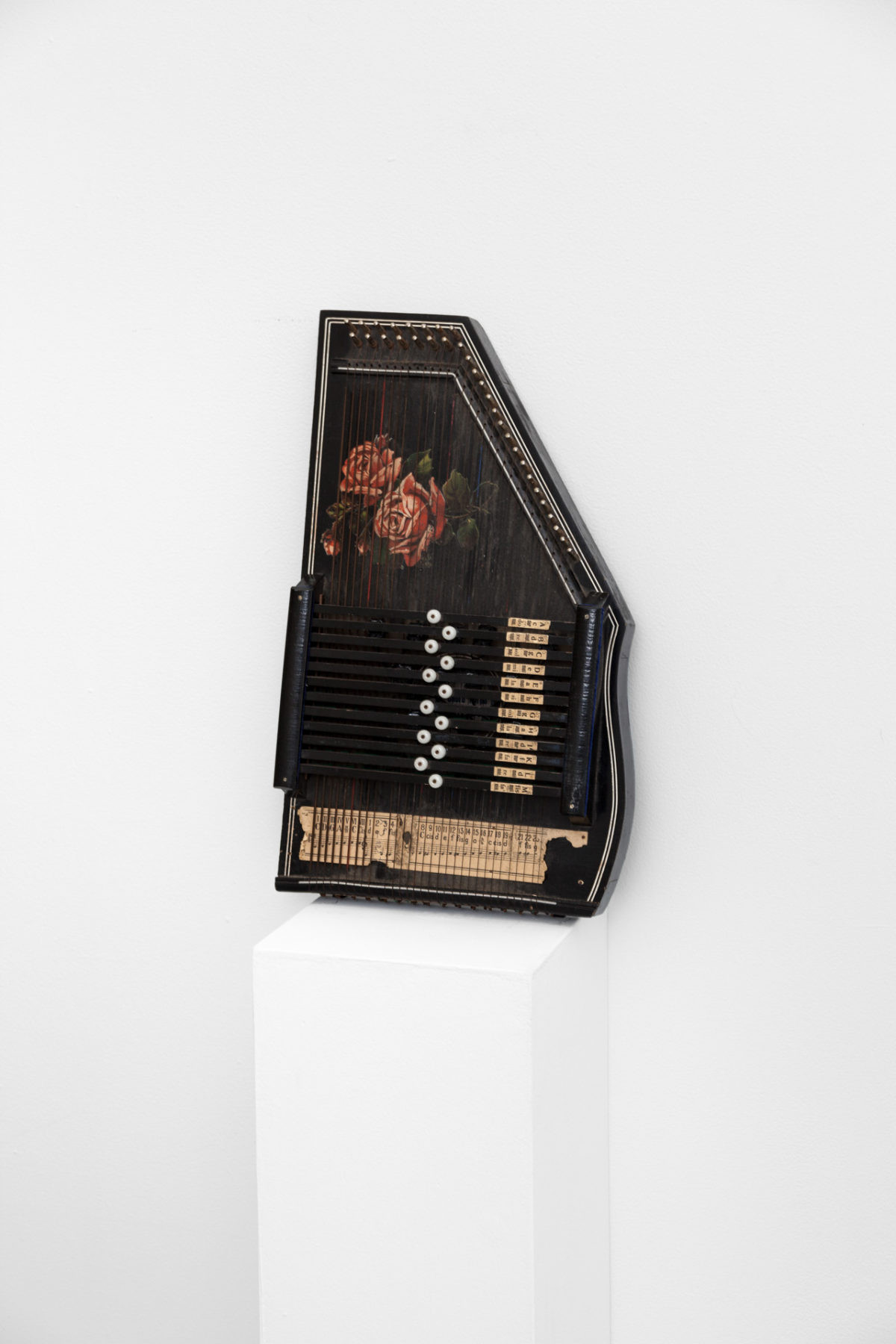
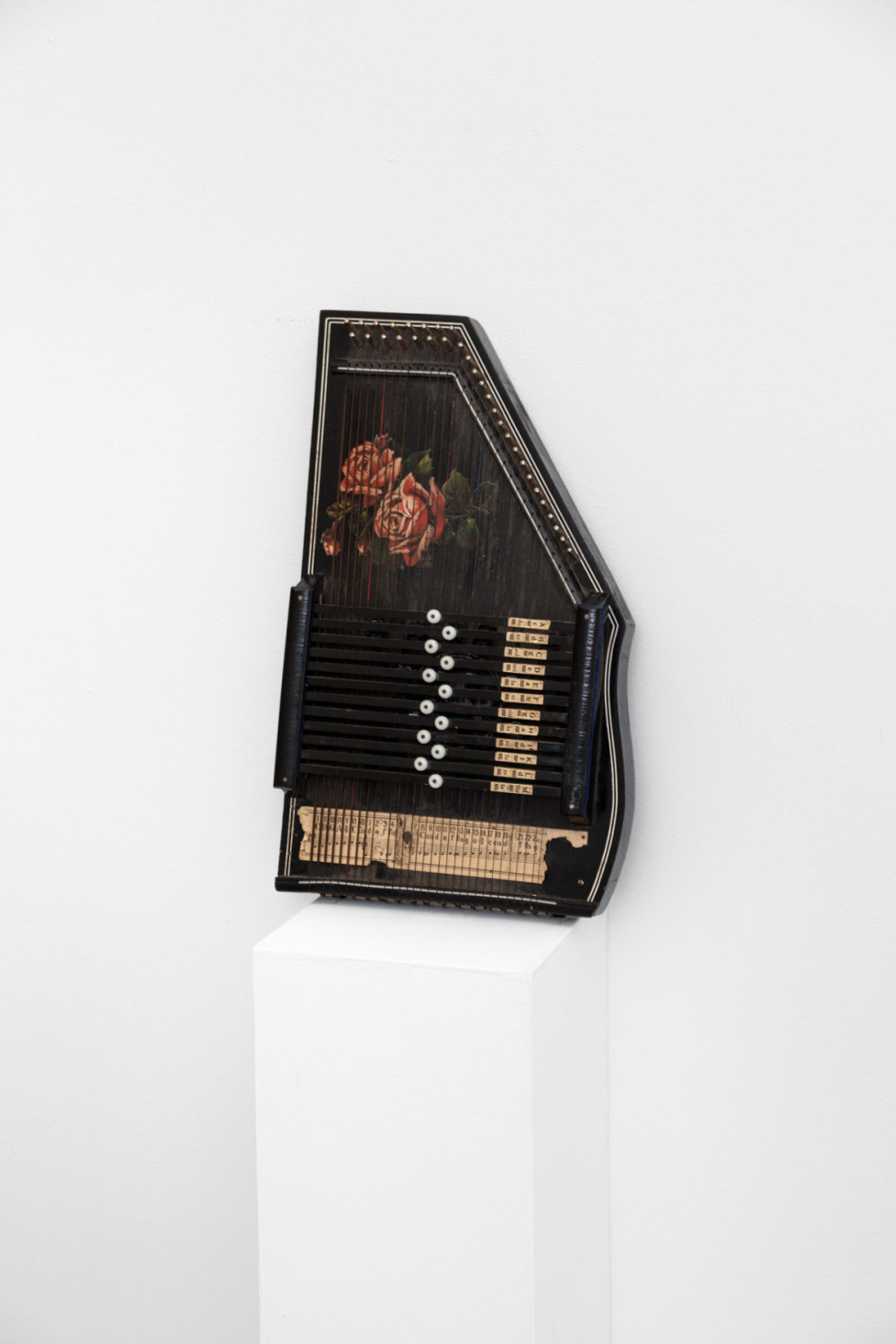
The vibrating strings of AUTOHARP (2016) ring out into the space. Through activating the strings of the instrument with electromagnets, Bruniges has created an autonomous sonorous object, devoid of a human plucking its strings. The choice of instrument seems significant here, a harp having both a mythic and divine history; indeed the only way Orpheus was able to woo the king of the underworld was through the sweetness of his harp. And in resonating the instrument in this particular way, Bruniges gestures to its history, to its time before: these notes could and would have been plucked at some point in the instruments life, and now resonate for an infinite duration. But there’s a tension in the subtle changes in tone, in the mutability of the sound; the exact nature of the autoharp’s drone is difficult to pin down, it oscillates depending on where you are in the room. Sometimes you will notice a shimmering high-tone or your ear will pick up a deeper pitch. And yet for all this change, it is also fixed, seemingly suspended in a continuous hum.
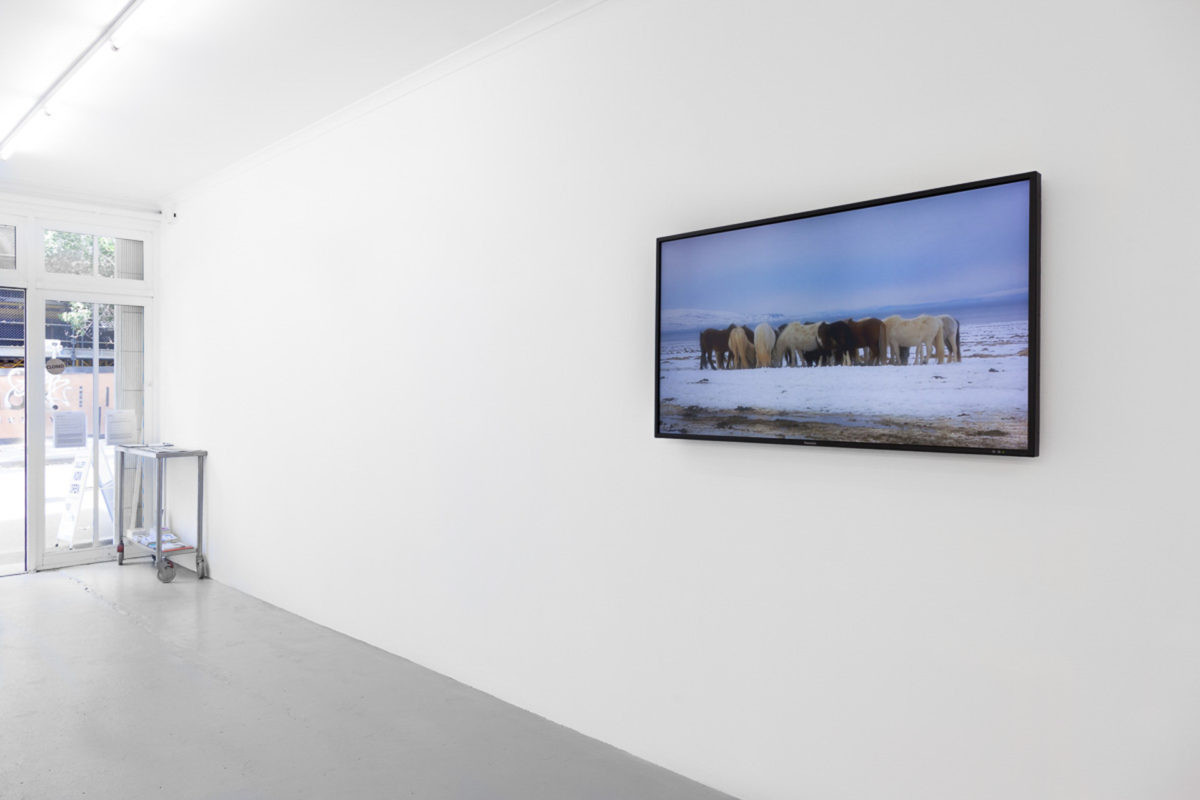
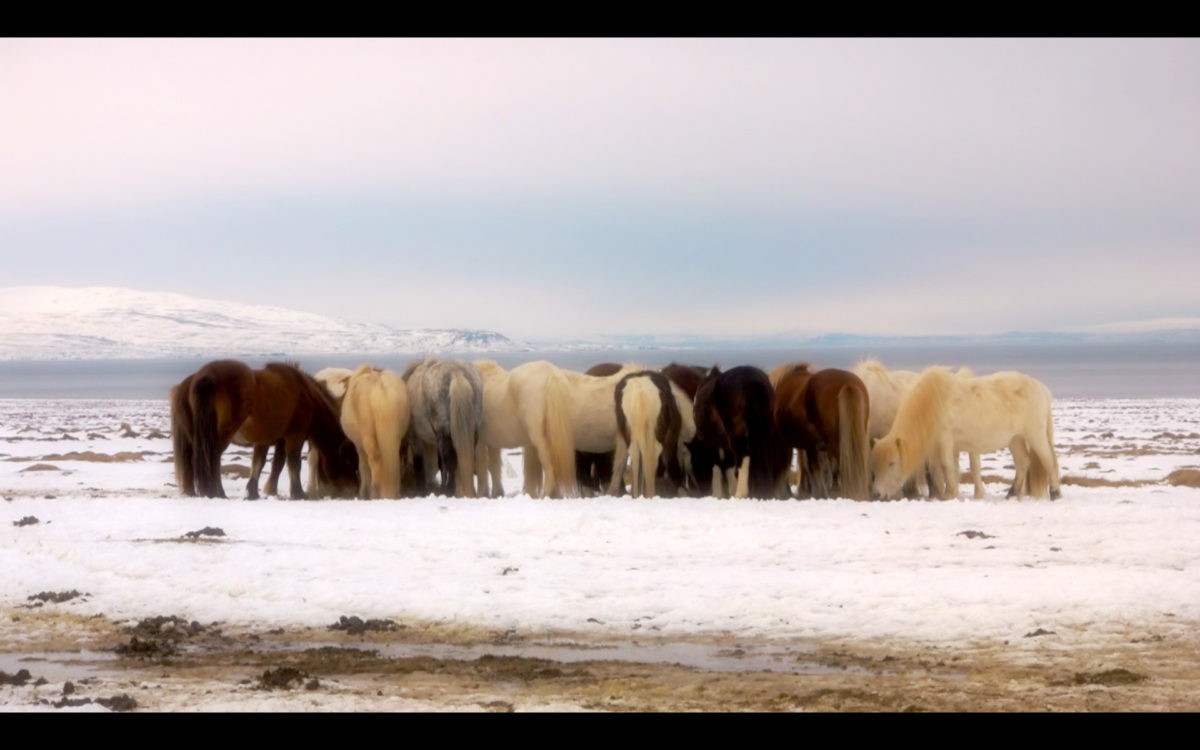
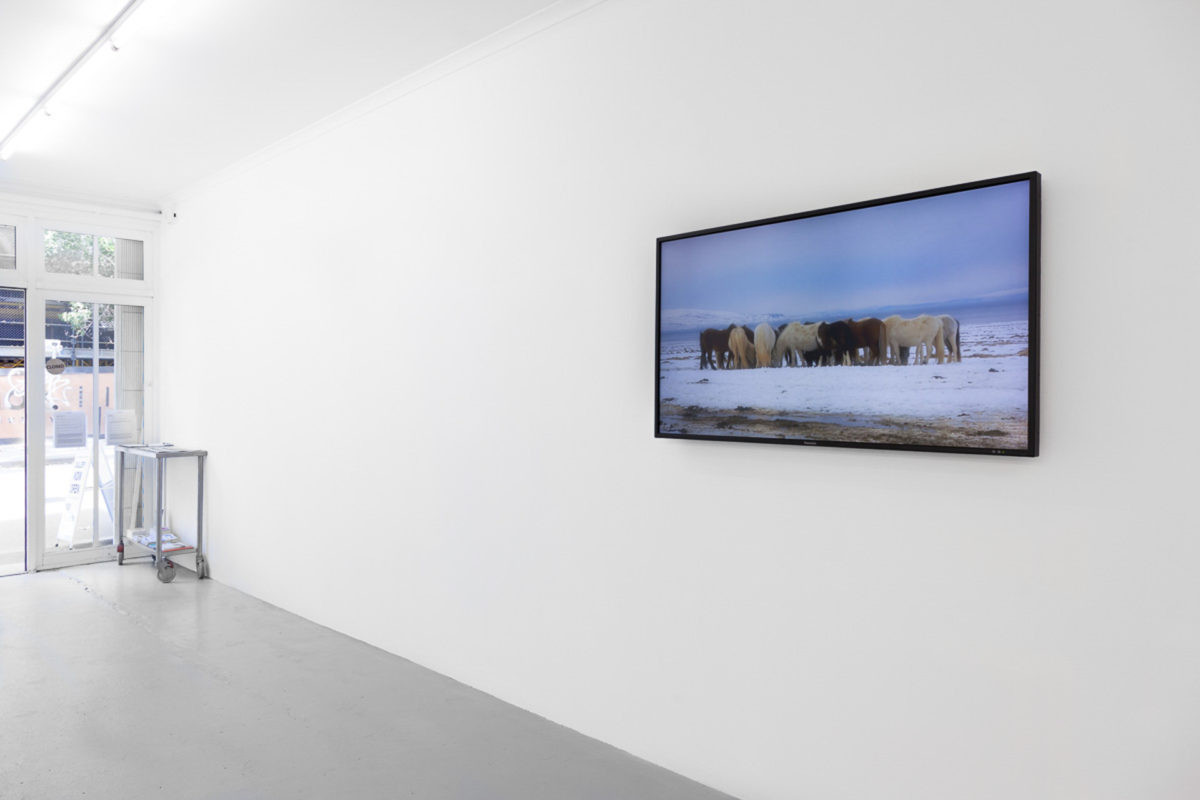
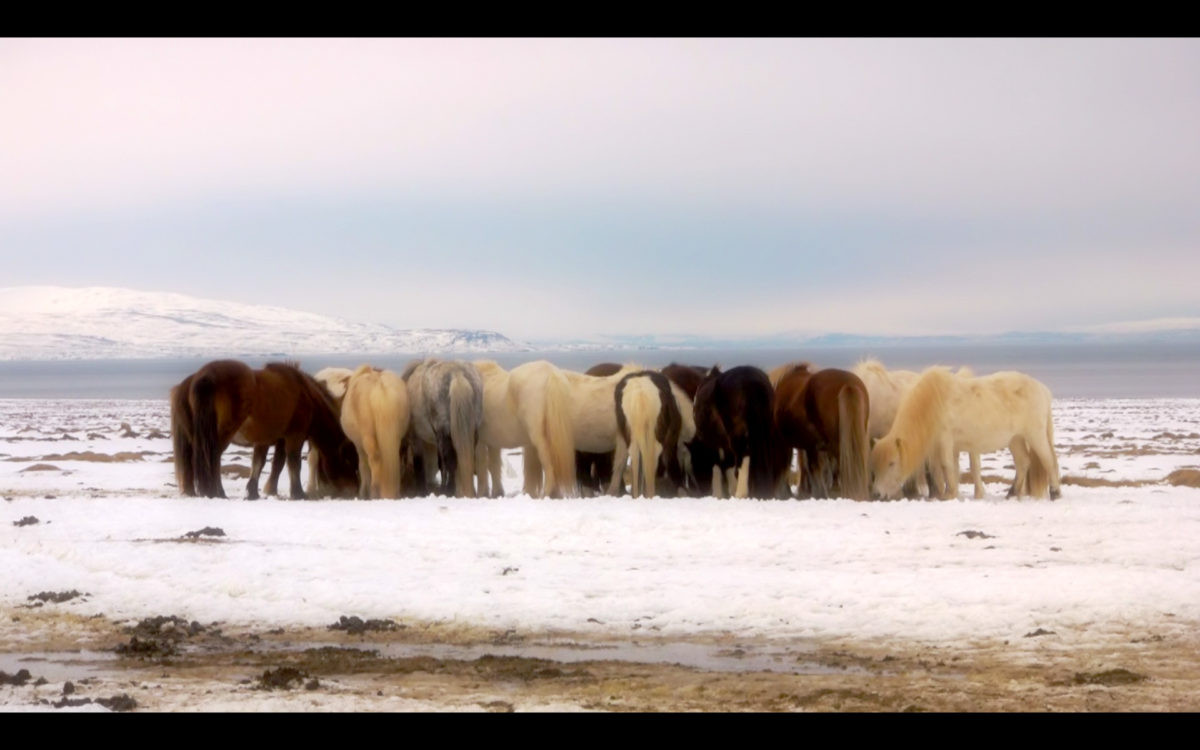
There’s a similar feeling of suspension as you stand in front of HORSES (2015), with a cluster of animals arranged almost symmetrically in the centre of the frame. Many of the horses have their heads down; a few are turned towards you, coffee crème manes set against a snowy background. The landscape, albeit beautiful in its stark crispness, becomes immaterial, rather your focus remains fixed on the bodies of the horses. Is it a static image you’re looking at? Does it change or did you imagine that lifted hoof? You look once, you turn away, you look back again; the scene will be different. You pause, hesitate – give it time – and you will begin to see that it is near impossible to discern where each frame starts and ends, where the next begins, but yes, it’s moving. Bodies merge, separate, and merge again, leaving blurry impressions and shifting blotchy shapes. And then again, like AUTOHARP, there will be moments where it may not appear to move at all. HORSES is a visual drone, both making and moving, humming along with the gentle arc of a horse turning its head. The effect is the obverse of Eadward Muybridge’s well-known early experiments in filming a horse: Bruniges is less concerned with a gallop than with a halt, a halt that is prolonged, extended and lengthened.3 ‘There is a secret bond between slowness and memory,’ writes Milan Kundera, ‘between speed and forgetting’, and it is in slowness that our sensory perception expands rather than shrinks.4
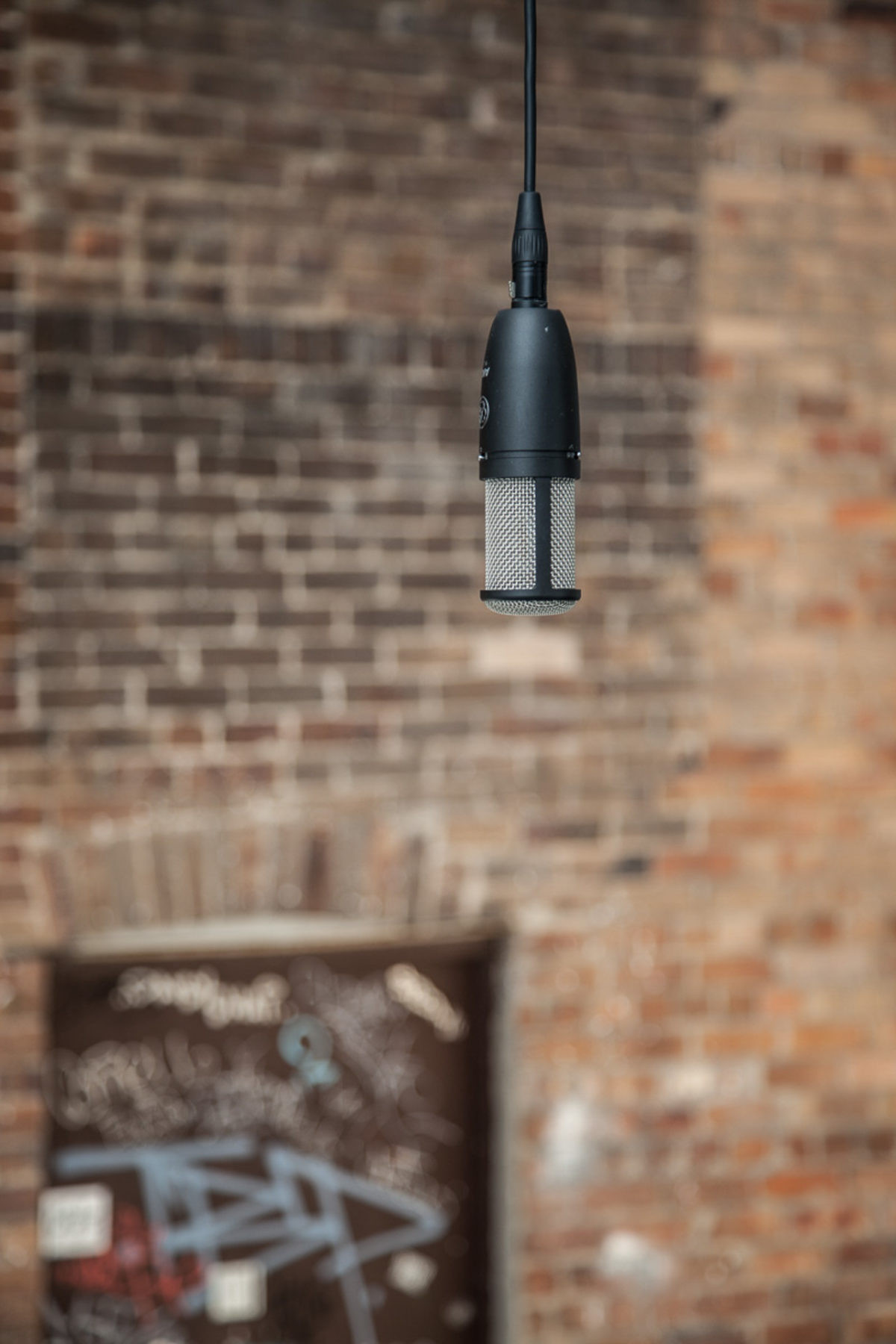
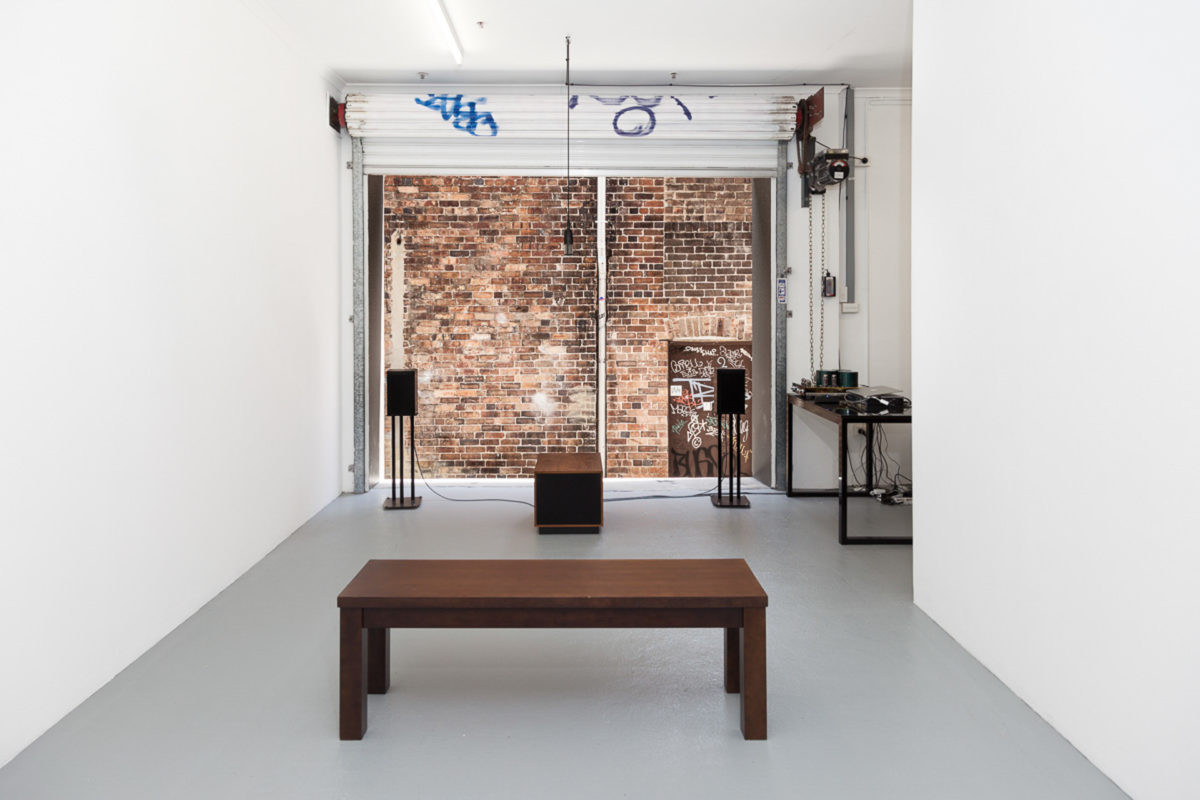
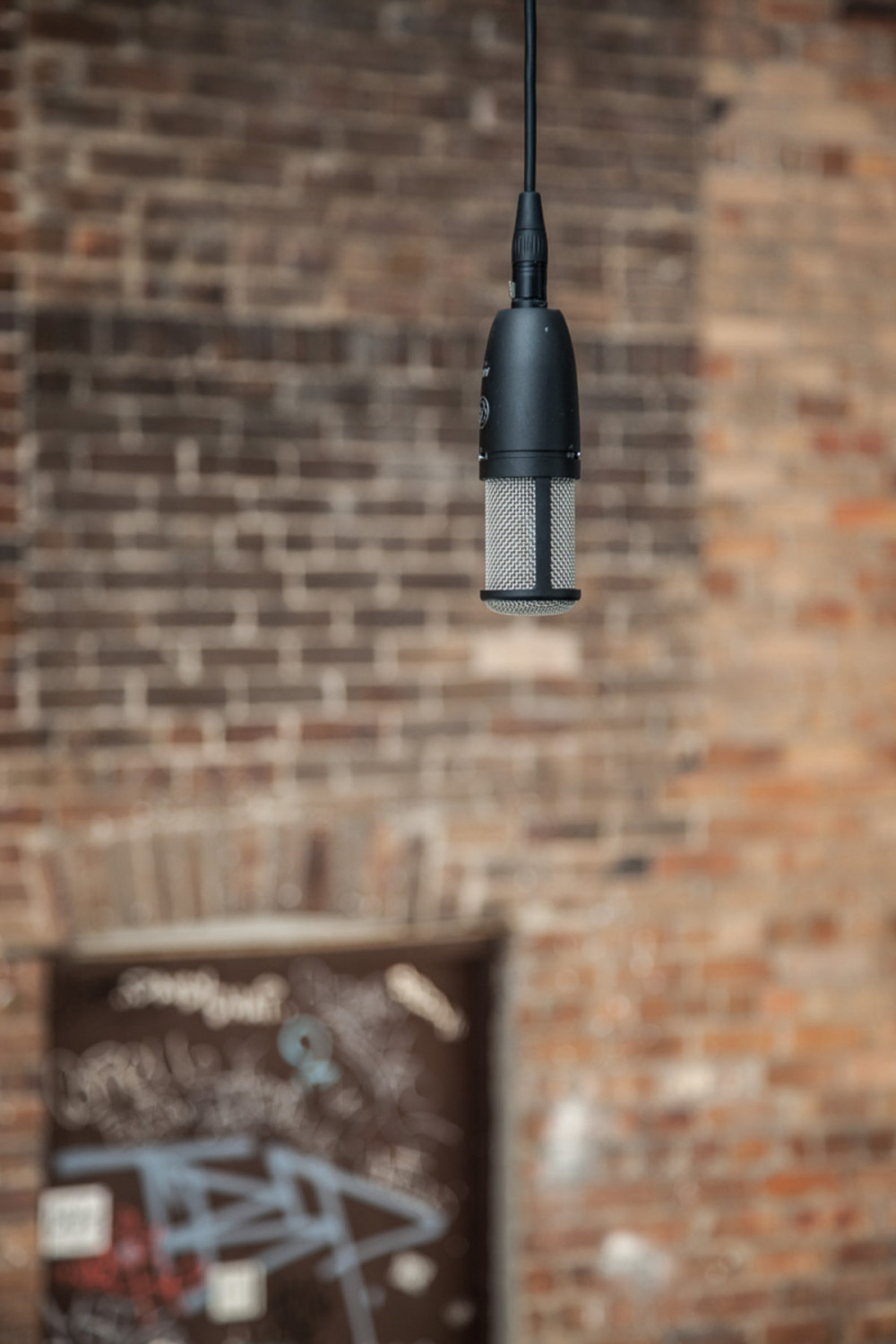
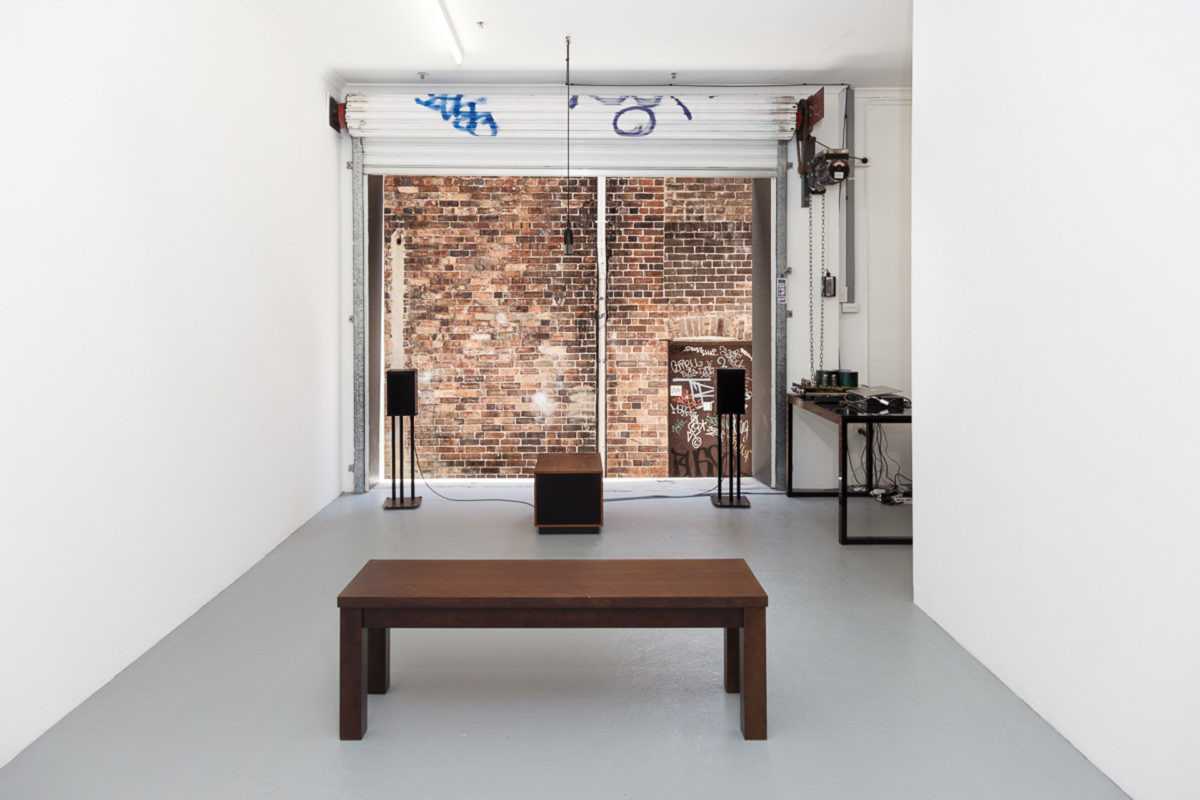
The way you stand in front of HORSES, or move around the AUTOHARP – how you inhabit the space – is important when turning to Bruniges’ final work, WALL (2016). The drone emanating from the speakers in front of the open roller door is live: it is active and generating from the present moment, as the work picks up the ambient sound of the environment, reconfiguring it and returning it back outward. For Kundera, ‘everyone seems to live inside an enormous resonating seashell where every whispered word reverberates, swells, into multiple and unending echoes.’5 Bruniges repurposes these echoes into a different kind of seashell, as the sounds that you or those around you make, even the singing tones of the autoharp, feed into the creation of the drone, giving immediacy to its stasis/flux binary. But it is the slowness, and how you interact with it, which necessitates an engagement with this particular paradox. And, as the name suggests, WALL plays with the architecture of sound: when you sit on the bench you not only hear a wall of sound, but are also facing the brick wall beyond it, even as the drone emanating from the speakers creates an invisible barrier between you and the bricks. It’s not one wall but many. Mikhail Bakhtin, in developing his theory of the novel form, writes about chronotopes – a word that mashes both time and space together. For Bahktin, a chronotope describes a narrative event where ‘time, as it were, thickens, takes on flesh, becomes artistically visible; likewise space becomes charged and responsive.’6 In this moment, ‘the knots of narrative are tied and untied’, and coherent meaning begins to unravel.7 You can think of Bruniges’ drones as chronotopes – decelerated arrhythmia at the exact point where time thickens and becomes more perceptible, just as the resonant nature of space is brought to the fore.
Edmund Burke wrote in his treatise on the sublime that ‘the ideas of eternity, and infinity, are among the most affecting we have, and yet perhaps there is nothing of which we really understand so little, as of infinity and eternity.’8 To experience DRONESis to have the usual definable parameters of both space and time reconfigured, to experience a kind of infinity. You find yourself caught between making and moving; you are enveloped in the roar of movement and the drowsiness of inertia.
Andrea Swensson, ‘The audacity of Low: What does a band ‘owe’ us when we pay to see them perform?’, The Current, <http://blog.thecurrent.org/2013/06/the-audacity-of-low-what-does-a-band-owe-us-when-we-pay-to-see-them-perform/>
Suzanne Buffam, ‘On Duration’ in The Irrationalist, (Ann Arbor, Michigan: Canarium Books, 2010), p. 42
A halt being the moment a horse stops all movement with all 4 feet equally balanced. It’s interesting to note that the Icelandic horses in Bruniges’ video have their own unique gaits, as well as the more tradition gallop, trot and canter. An Icelandic horse has a tölt, a kind of ambling movement, and the speedier skeið or ‘flying pace’. This makes the Icelandic horse, which is smaller – often pony-size – a rare five-gait horse. <http://www.icelandichorses.co.uk/the_special_gaits_of_the_icelandic_horse.htm>
Milan Kundera, Slowness, (London: Faber and Faber, 1996), p. 34
Kundera, p. 10
Mikhail Bakhtin, ‘Forms of time and of the chronotope in the novel’ in M. Holquist (ed), The Dialogic Imagination, (Austin: University of Texas Press, 1981), p. 84
Bakhtin, p. 250
Edmund Burke (1759), ‘A Philosophical Enquiry into the Origin of Our Ideas of the Sublime and Beautiful’ in Martin Price (ed), The Restoration and the Eighteenth Century, (New York: Oxford University Press, 1973), p. 601
Photos: Docqment