18 November – 6 December 2015
Giacomo Carmagnola
Alan Constable
Alison S.M. Kobayashi
Kyle Montgomery
Kenny Pittock
Patrick Pound
Tobias Yves Zintel
Curated by
Talia Linz
the thing that feels
How might we comprehend the curious mode of being of the inorganic? Mario Perniola asks, if feeling marks the boundary between the living and the thing, ‘how can one say that man is a thing that feels … it is not enough to add feeling to the mode of being of the thing to come up with man … Maybe the thing is a man who does not feel? Or who feels a little?’i The thing that feels draws together disparate practices that deploy objects in various forms as ciphers for communication. Given over to the inanimate, artworks explore often language- less, embodied forms of expression, revealing personal mythologies both real and imagined – from Tobias Yves Zintel’s protagonist, who is compulsively occupied with the pig and its representation, to the material and linguistic play in the work of Patrick Pound, and the found objects that fuel the character assemblages concocted by Alison M. Kobayashi. Here obsessiveness is both a mode of production – a way of dealing with an object and its symbolism: thoroughly, endlessly, mysteriously, intimately – and a communication strategy challenging notions of value and genealogies of use.
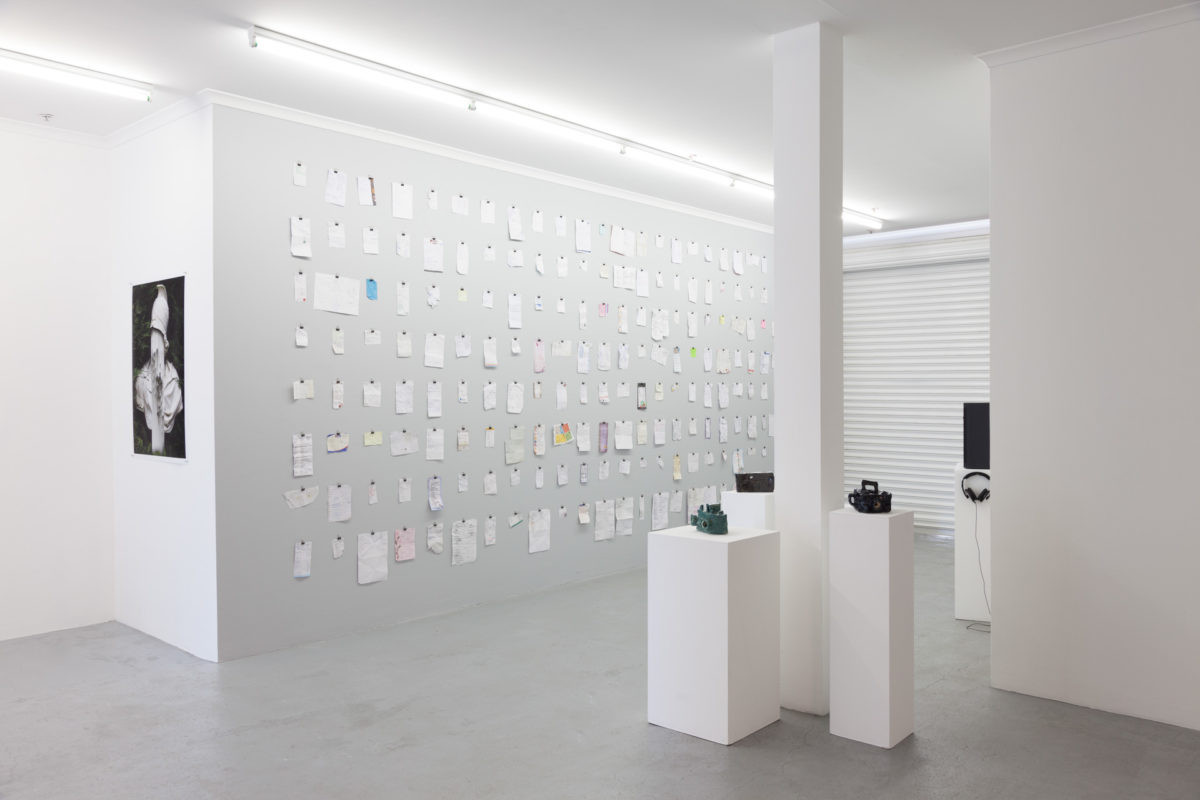
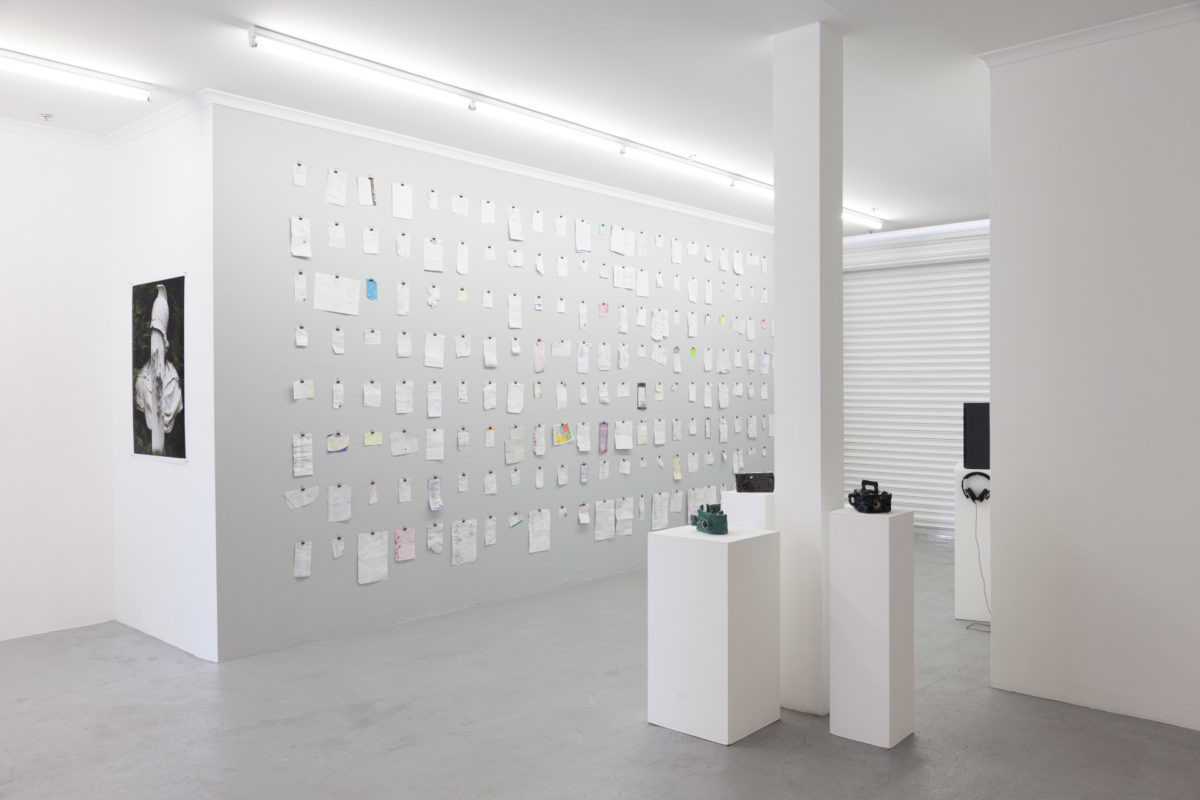
Kenny Pittock has been collecting discarded shopping lists for nearly a decade. In the age of smartphones the humble paper list has become much more of a rarity, and he has over 500 in his collection. Working at a supermarket during high school started the obsession, when instead of throwing out the crumped lists he found in the bottom of trolleys or the soggy ones stuck between cartons on the milk shelf, he took on the role of custodian, storing them neatly in plastic sleeves for later use. Each is a list of things and an object in and of itself, which bears the unique marks of its previous owner and their particular way of categorising and remembering. Removed in time and space from their functional purpose, each becomes a weird sort of poem, whose words and aesthetic take us on small flights of fancy.
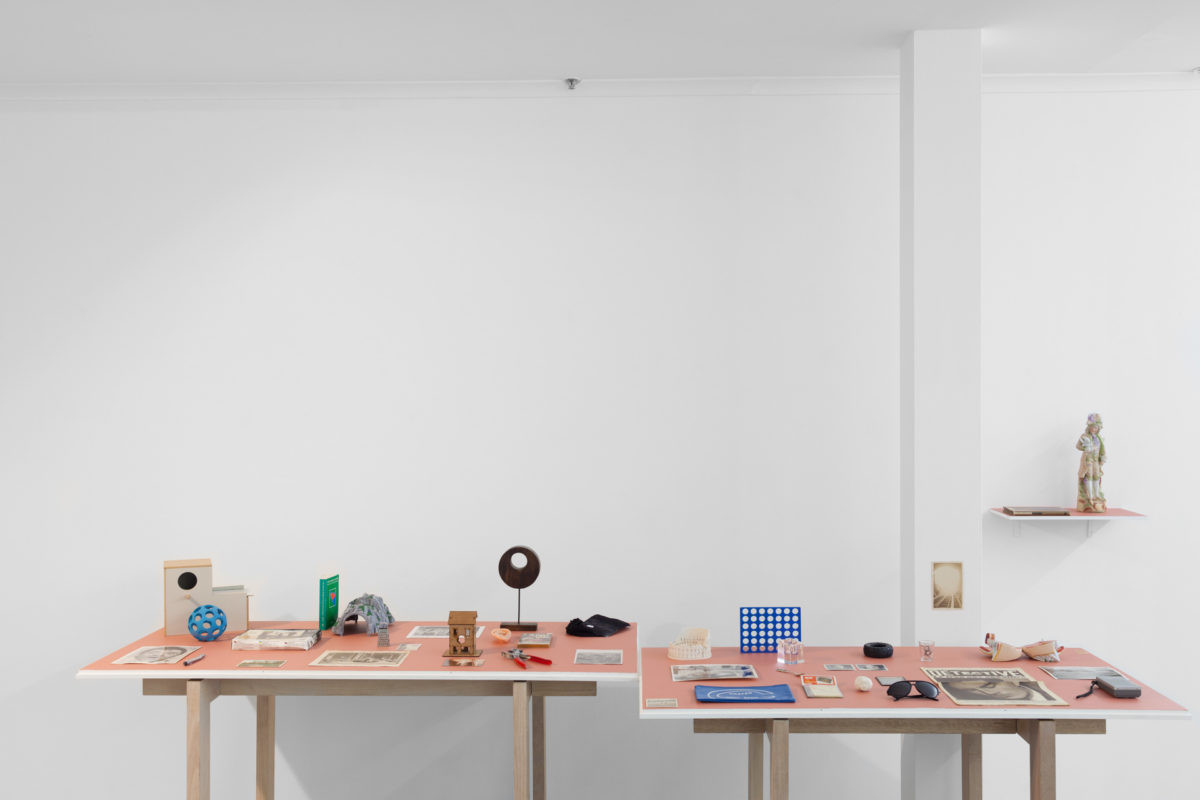
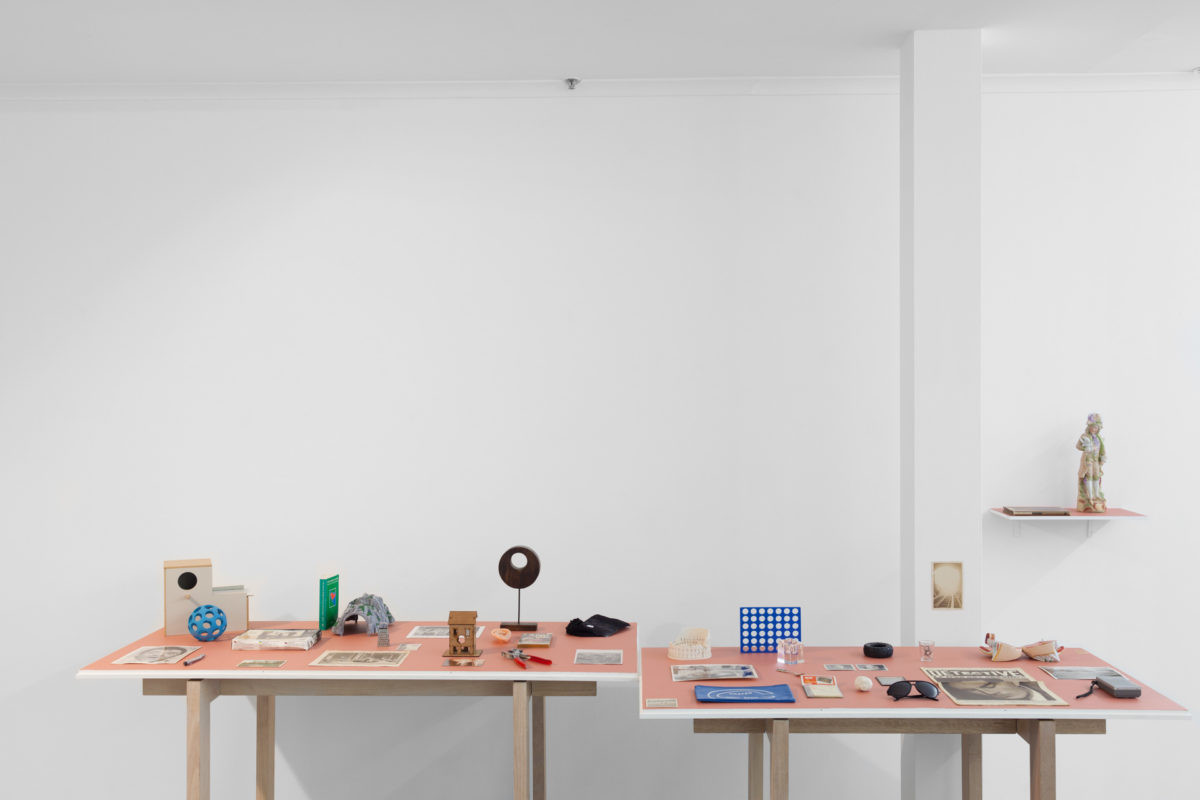
Patrick Pound presents us with a puzzle that has already been solved – the title of the work, Museum of Holes, gives away the game. He is interested in how inanimate things can hold ideas, both literally and in our imaginations. Each one of these objects – a small slice of a much larger collection – connects with the idea of a hole, either in their physicality, their feeling, by visual demonstration or illustration, by name or in the context in which they are found. Assembling collections of things and ideas is a key part of Pound’s practice, and he has amassed boxes and boxes of material for ever-increasing bodies of works, from a group that focuses on falling, to air, whiteness, and photographs of people who look dead but (probably) aren’t. There is pleasure and humour in recognition, relationships built between objects by juxtaposition and accumulation, as well as a comment on the hierarchies implicit in traditional museological modes of display. Like Pittock’s, Pound’s are not valuable art objects. They are largely inexpensive things gathered in second-hand stores, off the street and by trawling online. These are ‘not cool, not kitsch, sort of matte … slightly past their use-by-date, almost redundant things’, Pound says. ‘I want to upset the false need for things to be fixed in their meaning. I want them to behave more like words; to give them more flexibility and put them back to work.’
Alan Constable has had a life-long fascination with vintage cameras, which began with him making replicas from cardboard cereal boxes and tape as a child. Constable is legally blind with limited tunnel vision, which perhaps contributes to his affection for objects dedicated to capturing images. Each ceramic camera is tenderly constructed, character-full and retains Constable’s marks of construction in its shape and on its surface. Unlike the original technical instruments, Constable’s mischievous creations seem to bend and ooze, and we can imagine any photograph taken would be equally unexpected. They are more riffs on the idea of a camera, with endless possibilities and boldly coloured glazes, than an attempt at judicious replication. Although largely obscured from view, internal chambers and walls are also finely constructed, enclosed within the ceramic outer shell. These are an important component of the artist’s tactile mapping of his objects, which exude an idiosyncratic confidence and seem to desire to be touched and lifted to the eye.
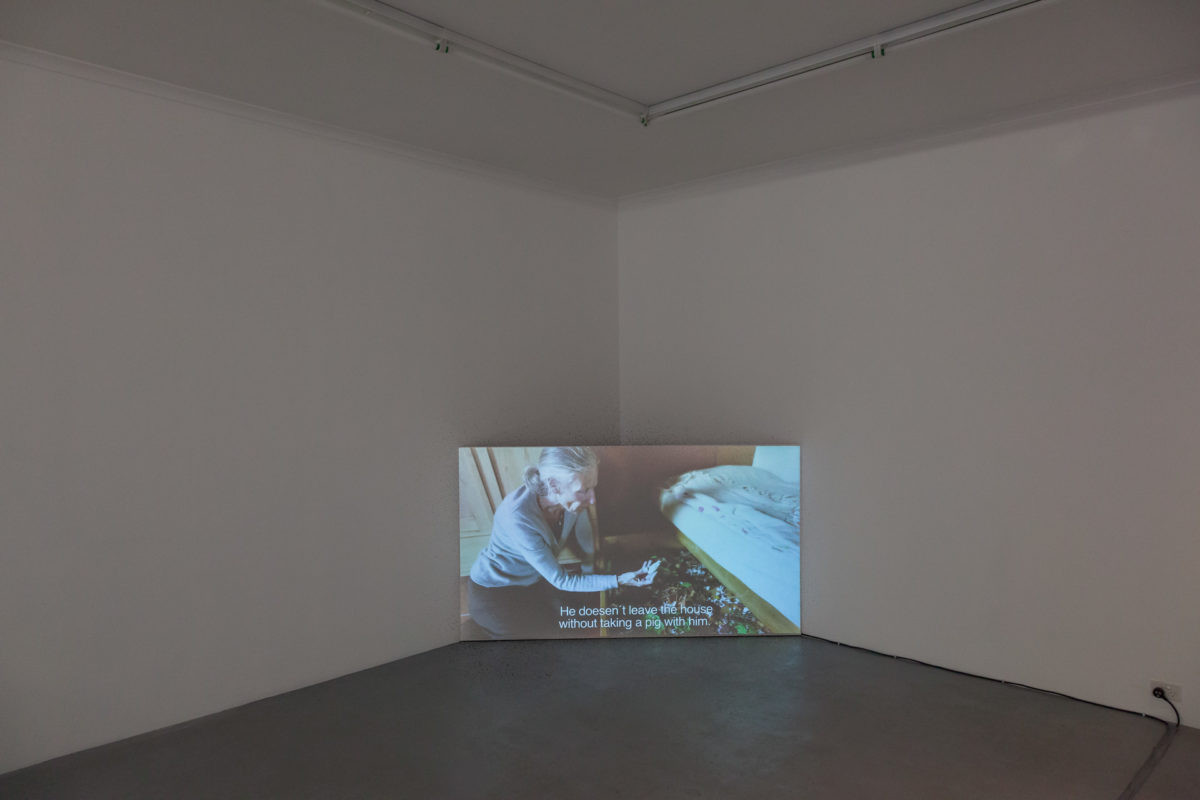
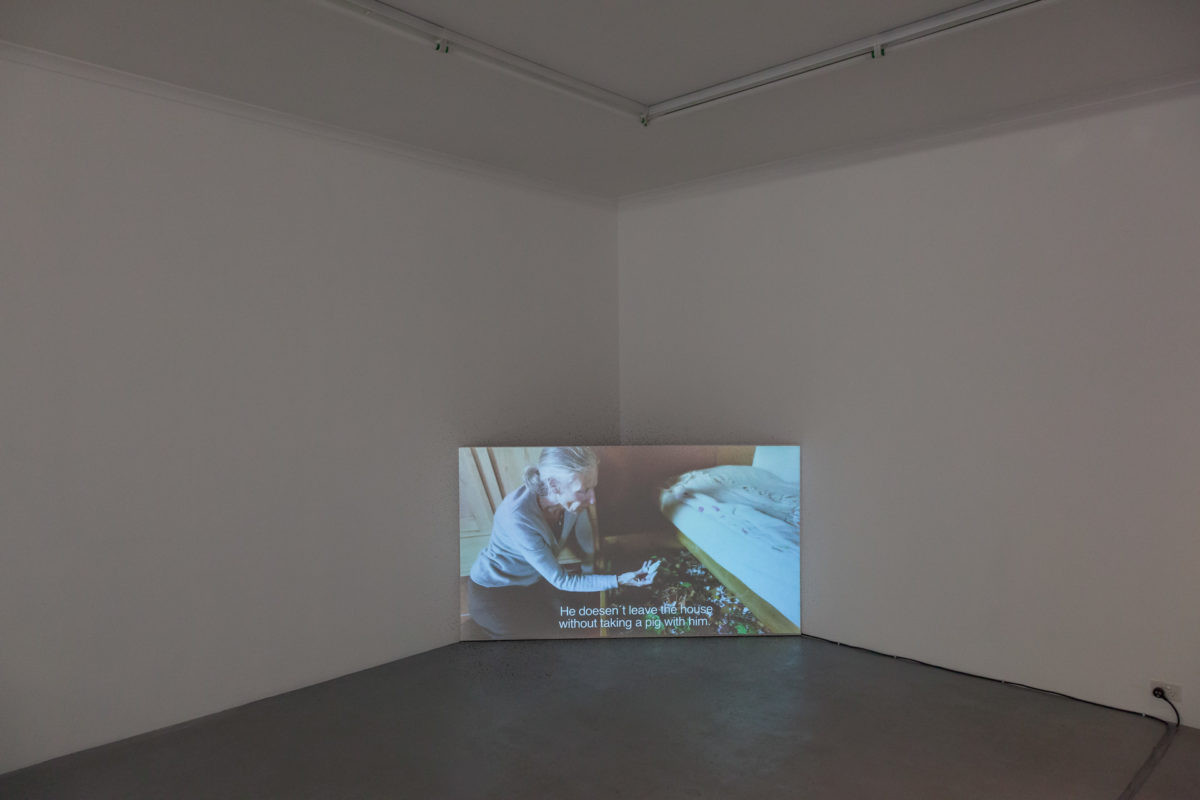
Tobias Yves Zintel’s Mental Radio is a moving-image portrait of the artist’s family. Filmed within their home and its grounds, the setting is a metaphorical framework for the social construct of the family. Characterised by Zintel’s surreal filmic style, the work borrows tropes from the documentary genre, with interviews of his parents reflecting on his autistic brother Marcus’s behaviour and unique interaction with the world. Over the years Marcus has made countless drawings of his favourite animal, the pig, which his mother has kept and filed away. For him, the pig and its representation seem to act as personal totems of a sort: a consistent thing to help him process and perhaps communicate his internal life. At one point in the film, Zintel’s father watches a lecture by the seminal philosopher Martin Heidegger in which he states that ‘man uses language and he has a knowing relation towards being’. His dad reflects that Marcus, who cannot name things and situations, must have his own terminology which can’t be deduced from the outside. The film’s title is taken from a 1930 book by Upton Sinclair that describes the experiments conducted with his wife, who he believed had telepathic powers. Objects, such as a tree house built by his father, and an ectoplasmic sculpture made of meringue baked by his mother, replace verbal exchanges in the Zintel house.
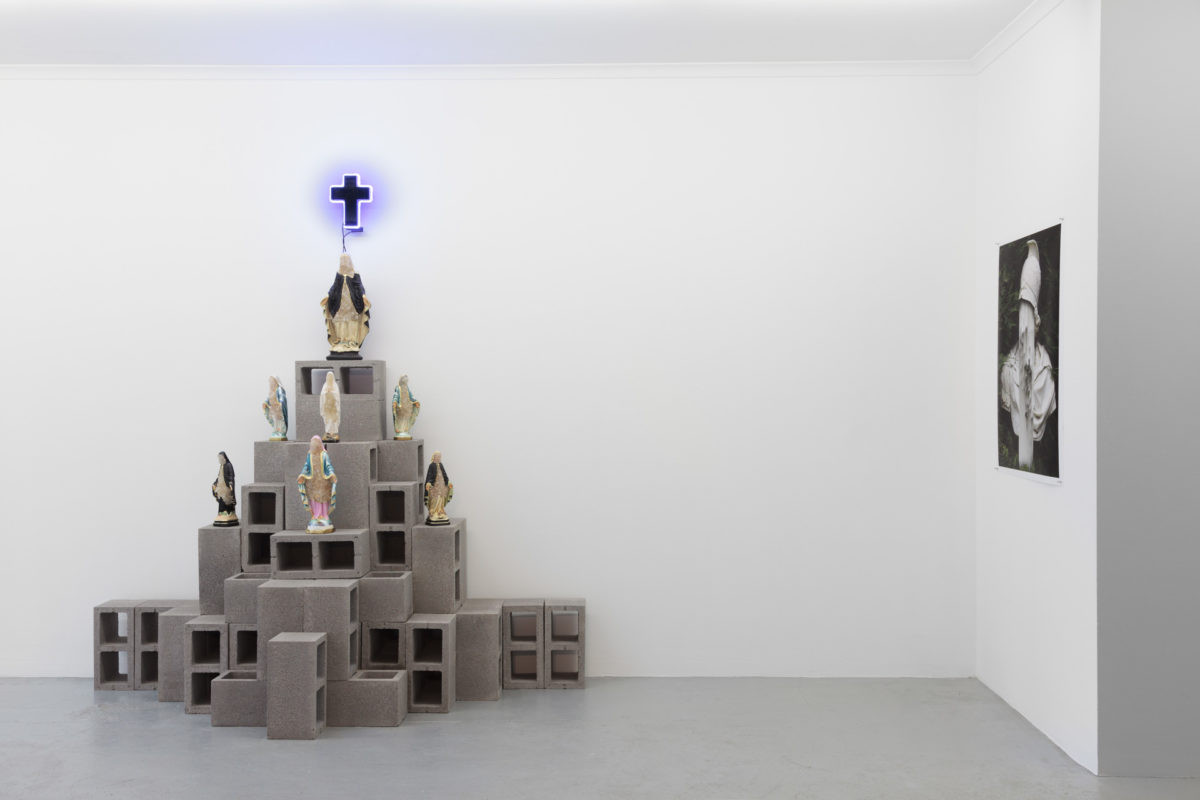
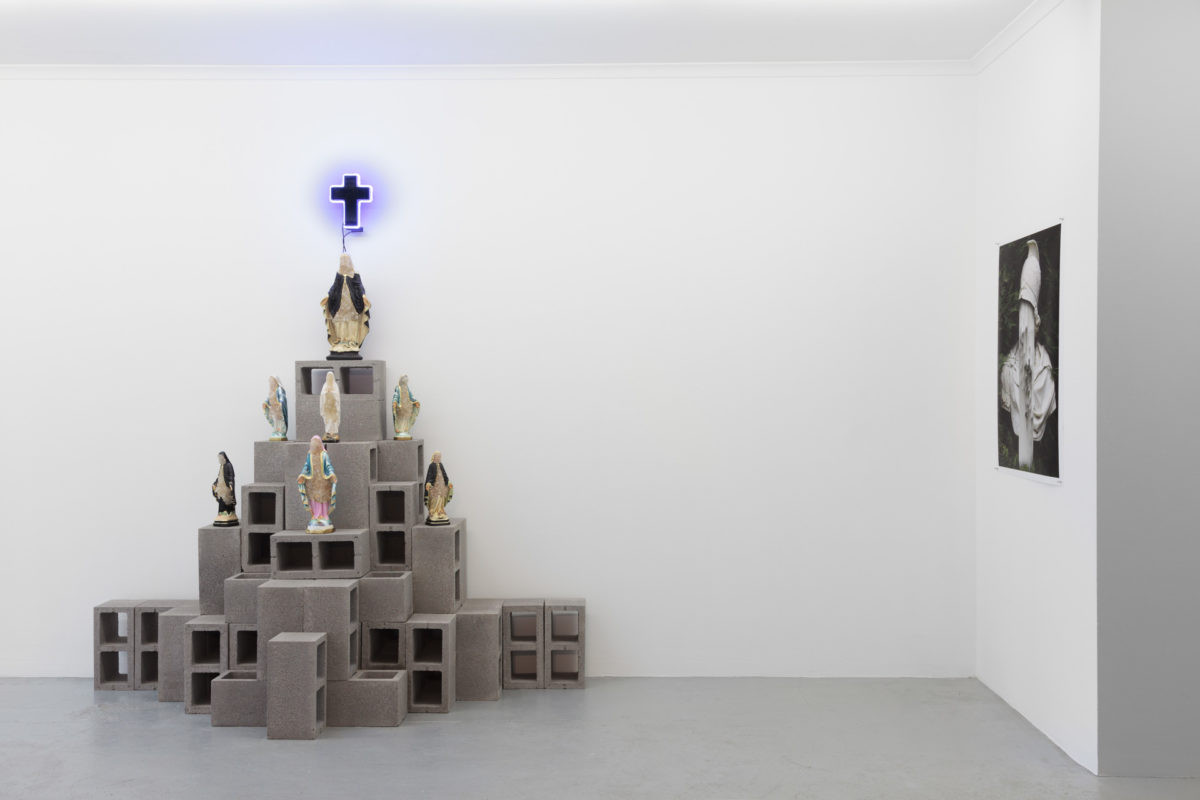
Kyle Montgomery works with found objects of specific religious significance, mining online auction and trading sites for second-hand Mary statuettes found in church displays or homemade holy sanctuaries. Literally and symbolically dissecting these familiar forms, he painstakingly fills in the voids with thousands of individual crystal shards, creating a hybrid totem of the man-made and natural worlds. Rivalled perhaps only by Christ on the cross, the image of Mary is one of the most pervasive in the Christian faith and so too in the western art canon. The artist exclusively selects pre-owned Marys, so they bring with them not only religious symbolism but a life before this incarnation – and the prayers and hopes of previous owners. Montgomery sensitively repairs damage and cracks, restoring enough of the original form for its iconic symbolism to remain intact, yet making additions so that each object takes on a new kind of potency, kitsch and beautiful at the same time. The sight of a Madonna is intended to bring spiritual relief and to inspire piety through the beauty and tenderness of the prototypical mother figure. In Montgomery’s hands, organised religion and a hint of the new age co-exist in the same form. His works poses questions about the function of the icon, the commodification of spirituality, and the nature of faith and artistic labour in a contemporary moment characterised by material consumption.
Alison S.M. Kobayashi’s personas are inspired by her extensive collection of lost, discarded and donated objects. Dan Carter was born when she discovered an old answering machine in an op shop, complete with cassette tape and messages addressed to someone called Dan Carter. The work is structured around the messages left on Carter’s machine, which served as inspiration for the cast of characters each played by the artist herself. Fashioning intricate sets and costumes, she studiously and playfully embodies his callers – from a church counsellor to his concerned fiancé – reviving the life of the eponymous Carter with humour and pathos. Kobayashi’s work playfully investigates how objects can hold stories and narratives that migrate with their movements, evolving as they change hands. The low budget, analogue technology purposefully employed by the artist evokes a nostalgic familiarity. She raises questions of identity and ownership, fact and fiction, as objects facilitate a meeting of worlds, both real and imagined. Kobayashi’s The Possessed Artifacts and Detritus of Mrs. Florence Hazel Davis Bland is an online extension of the thing that feels (http://www.asmk.ca/bland/, best viewed in Google Chrome) – an interactive website that functions as both historical fiction and a eulogy for mundane museum items, which are memorialised and given new life through the artist’s digital reimagining.
Adopting the language of contemporary technology in a different way, Giacomo Carmagnola is influenced by the ever-evolving genre of glitch art, which turns corrupt data, malfunction and technological error to aesthetic advantage. Starting with source imagery found online, the artist combines representations of traditional sculptural works (that often celebrate or immortalise military and political figures) with a pixel-sorting algorithm, to create hybrid digital photographs that play with the material potential of the digital. His work speaks to the notion of the image as an object and to the longstanding discussion around what reproduction means for the so-called aura of the original.
Talia Linz
i Mario Pernola, the sex appeal of the inorganic: philosophies of desire in the modern world, Continuum: London, 2004, p. 5
Photos: Docqment