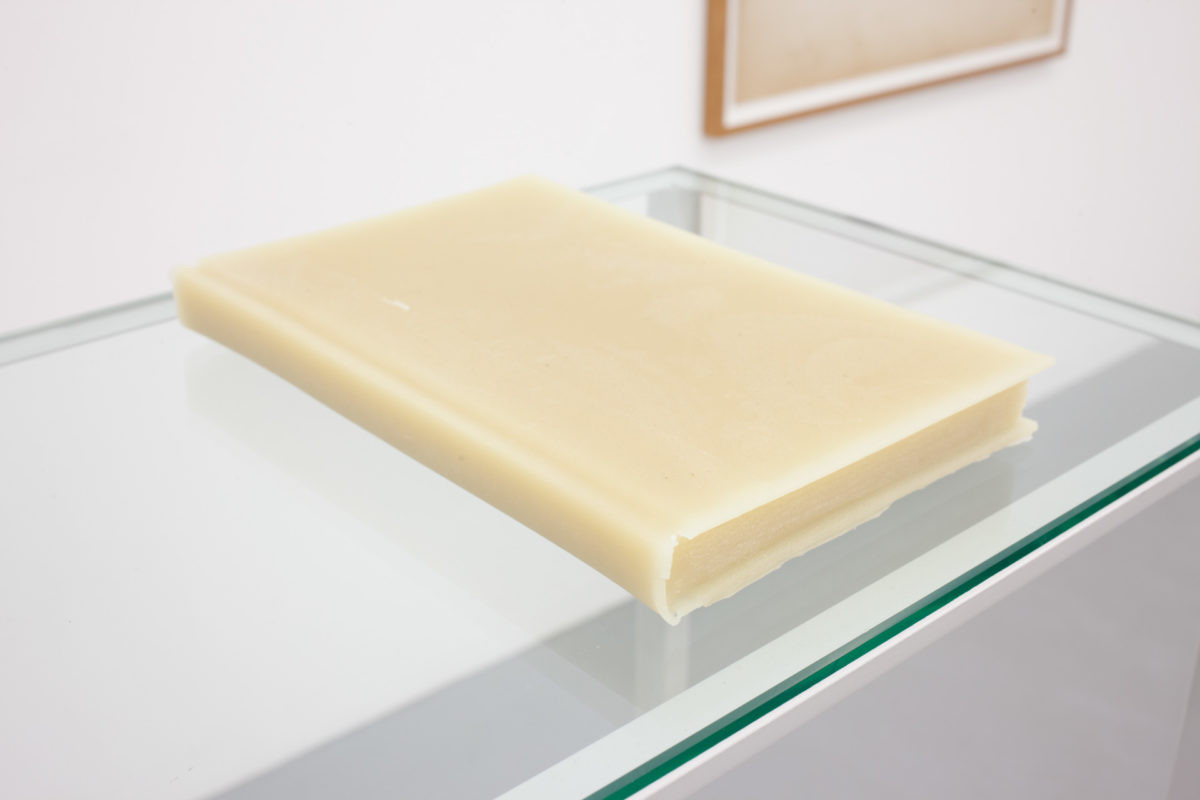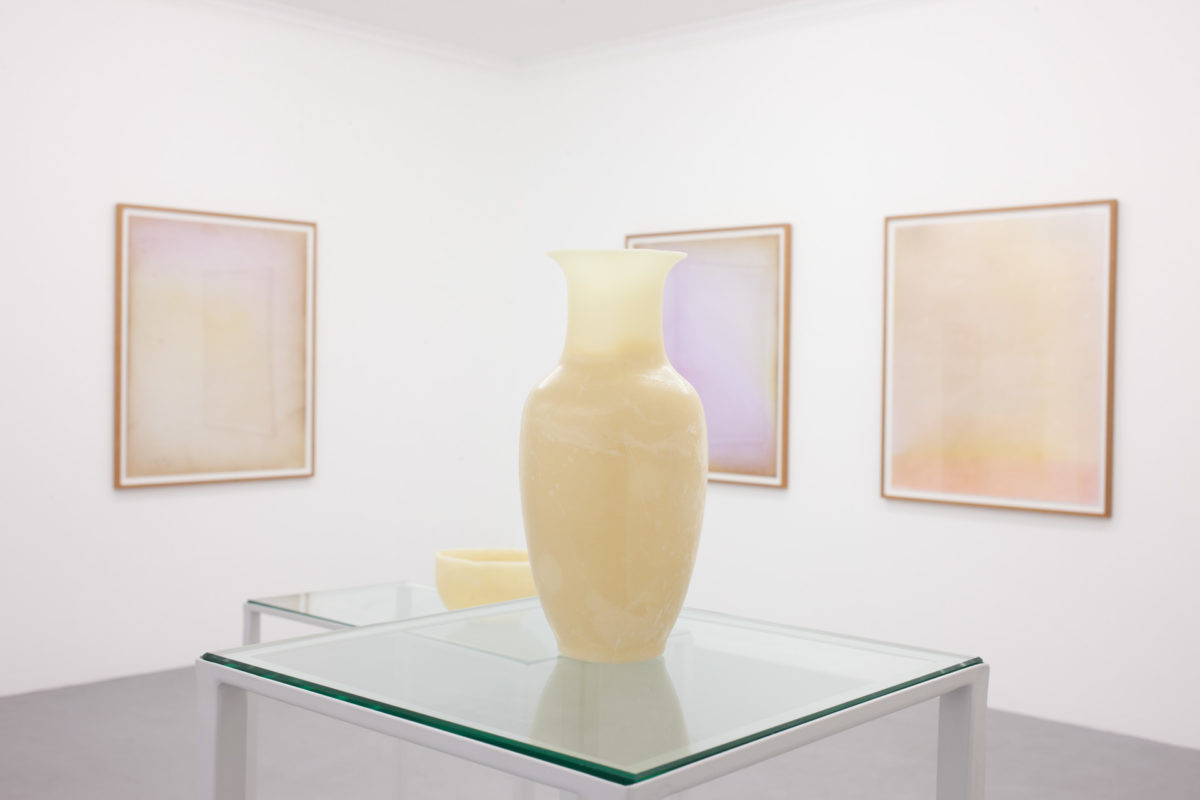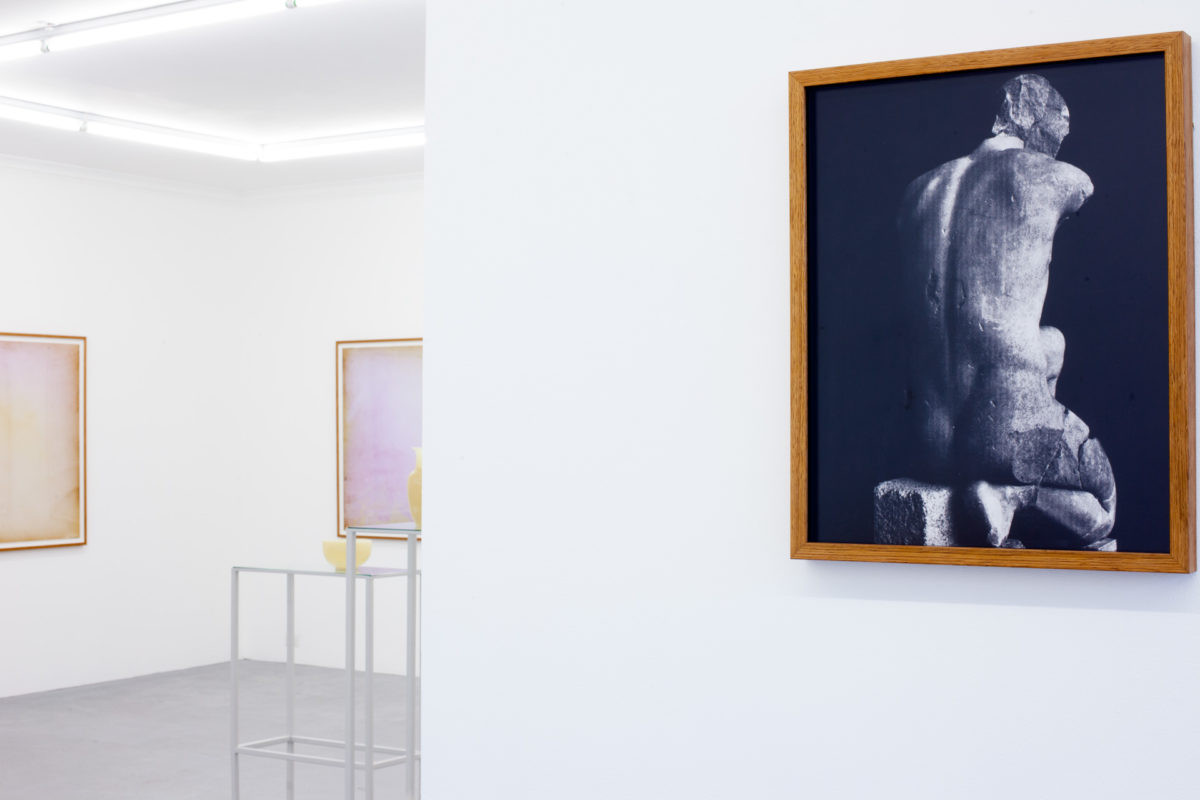

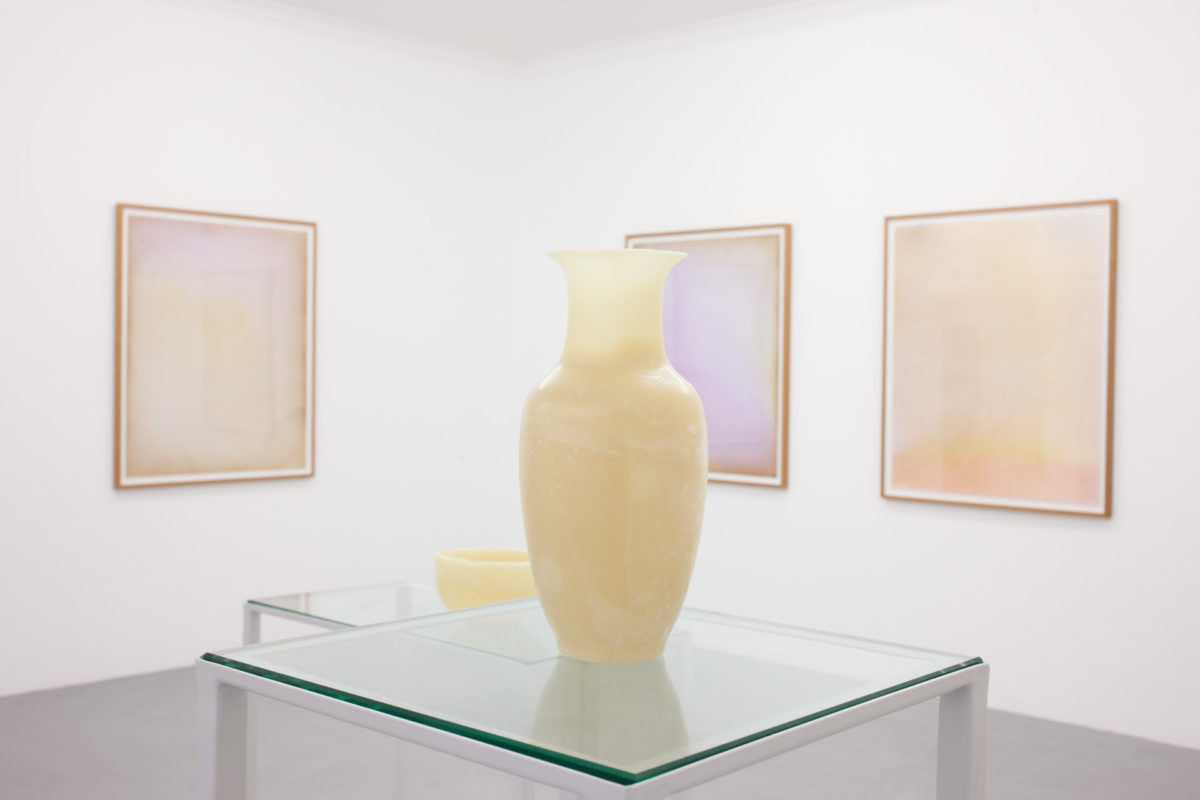
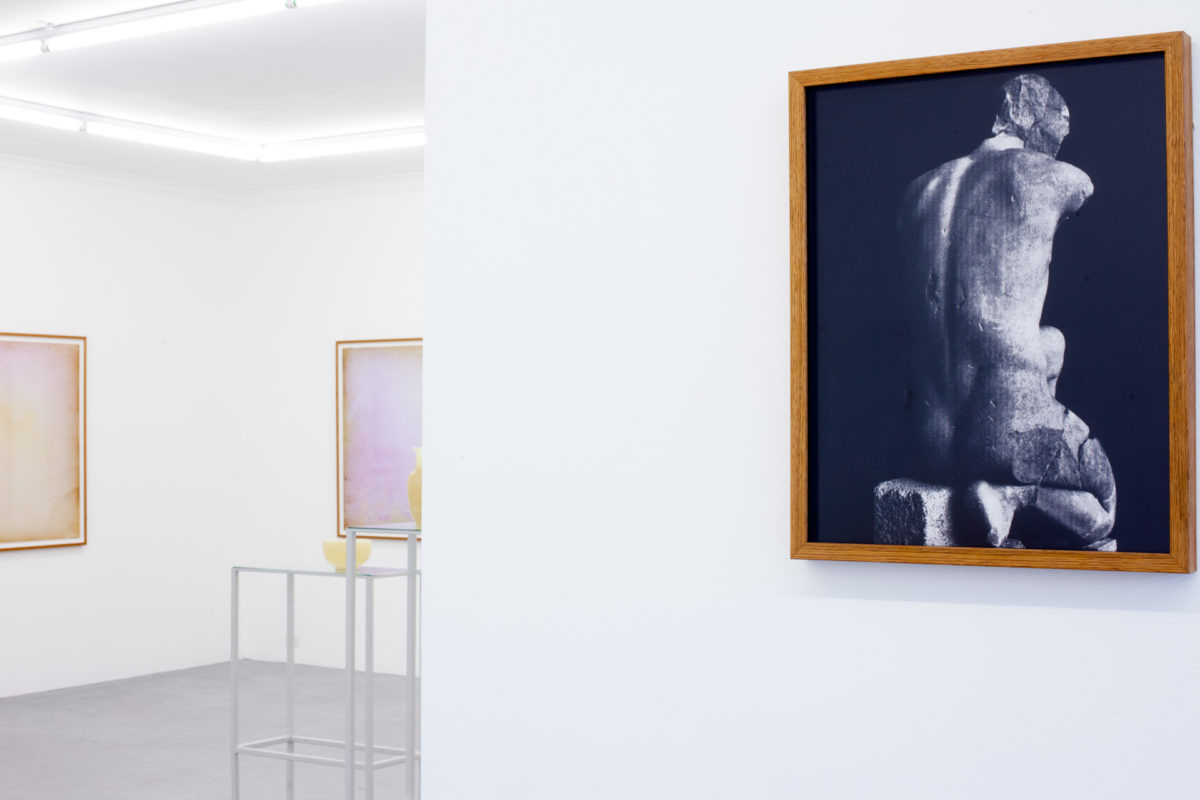
In 2013, Sarah Mosca went on a series of long walks through the mountainous Abruzzo region of Italy, with single sheets of large-format colour negatives attached inside her clothing, across her chest. Over the duration of each walk, a single long-exposure photographic image would be inscribed into the film surface. The photos were then developed, scanned, printed and framed for the exhibition Useless Gestures. As nebulous, semi-eroded fields of violets and ambers without any recognisable forms, they don’t look like landscapes or portraits – but each one is the direct result of the environmental conditions on the day of the walk; and of the walker’s body. Her movements, heat, breath and sweat each contributed to these dreamy pictureless pictures.
Walter Benjamin’s Little History of Photography (1931) features a haunting photograph of Friedrich Schelling from 1848. It’s a daguerreotype, so the picture is the one-off result of a direct, physical inscription into a photosensitive metal surface, over an extended duration. Sitters for studio portraits in the mid-nineteenth century were required to be still for as long as fifteen minutes, while their image was slowly carved into the daguerreotype plate. For Benjamin, this lengthy processing time allowed the subject to “grow into the picture.” In sharp contrast to the notion of the instantaneous snapshot that freezes a passing moment, Schelling’s portrait appears as a gradual focusing of his life and aura. And just as Schelling has grown into this lasting picture, the coat that he wears in it has, bit by bit, taken on the form of his body. Benjamin writes of Schelling’s coat, “the shape it has borrowed from its wearer is not unworthy of the creases in his face.” The well-worn garment and the wrinkled face are marks of longevity; like a daguerreotype photograph, they carry unique, accumulated imprints of time.
In 1996, some men robbed a bank in Spokane, Washington State. They wore balaclavas and gloves to hide their identities, and their generic outfits of sneakers, parkers and jeans further obfuscated their individual bodies. But when the CCTV footage ended up at the FBI Laboratory’s Special Photographic Unit, close inspection of the seams of one of the robber’s jeans revealed unique characteristics that ultimately led to the suspect’s prosecution. Despite their ubiquity, it turns out that mass-produced denim jeans can carry very distinct visual information. Over time, jeans accumulate particular patterns of wear and fading, depending on the shape and posture of the wearer’s body, the way they walk and sit, what they carry in their pockets, the way they wash the jeans, and so on. Kitty Hauser wrote an excellent article about this, which was published in the Journal of Material Culture in 2004. According to her, the Spokane bank robber’s jeans are a reminder that unique identity “is encoded not just in the body (in the face, in fingerprints, or in the DNA encoded in an eyelash), but in its cultural wrappings too, in the very fabric of its disguises.”
If you are wearing jeans right now, think of them as photographs. The fade patterning on the fabric surface is a distinct arrangement of light and dark – photo graphé. The seams and hems probably show the most pronounced patterning. These parts of the garment tend to have unique ridges, where the pigment becomes unevenly distributed, making them as distinctive as fingerprints, or barcodes, or the mountainous terrains of Abruzzo. Like Sarah Mosca’s ambulatory photograms, the fade patterns in your jeans carry after-images of corporeal presence. Through direct physical contact, over long durations, a moving body has inadvertently inscribed itself into a surface. The body isn’t shown as a delineated form at a specific moment, but through a gathering of traces built up over spans of time, so that objects dissolve into process.
Amelia Groom
Photos: Docqment